
Discover Laughing Gym Mushrooms
Enthusiasts know Laughing Gym as the common name for Gymnopilus junonius. This visually striking psychedelic mushroom species appears across the globe . Unlike cultivated Psilocybe cubensis strains, this fungus decomposes wood. It grows in dense clusters at the base of trees or on stumps and logs . Its large, vibrant orange fruiting bodies have earned it names like “Laughing Cap,” “Laughing Jim,” and the Japanese “Waraitake” (laughing mushroom) . Consequently, this species has fascinated mycologists and psychonauts alike for generations.
The scientific classification of this mushroom has a complex history. You will often see it referred to by its synonym, Gymnopilus spectabilis . However, G. junonius is now the accepted name, though older sources may still use spectabilis.
A very similar species called Gymnopilus ventricosus also carries the common name “big laughing mushroom.” This situation creates significant identification challenges . For this reason, people often mistake it for non-psychoactive lookalikes like G. ventricosus, which contains no psilocybin . Furthermore, recent studies suggest that true G. junonius distribution requires more research. Similar-looking species likely fill different ecological niches across various regions .
Appearance and Physical Traits
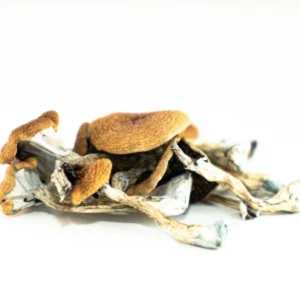
Laughing Gym mushrooms impress observers with their impressive size and vibrant coloration.
Cap
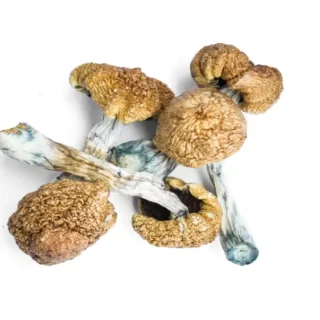
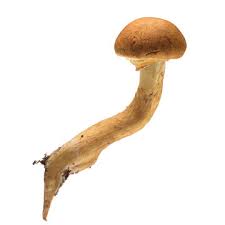
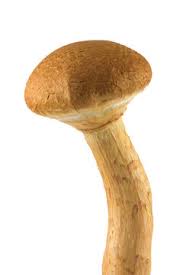
The cap is large and robust, typically ranging from 7 to an astounding 20 cm (8 inches) in diameter. Some exceptional specimens can even reach up to 42 cm . Young caps appear convex and gradually flatten as they mature. The surface remains dry and features a distinctive scaly texture. Its color ranges from bright orange to reddish-brown, slowly fading over time .
Stem
A long, thick, and fleshy stem supports the cap. It typically reaches 2.5 to 26.5 cm (1-10 inches) tall and measures 1-4 cm thick, often narrowing near the base . A fragile ring (annulus) sits on the upper stem. Rusty orange spores sometimes accumulate on this ring, creating a distinctive pattern.
Gills
The gills attach directly to the stem. They appear yellow in young specimens, gradually maturing to a rusty orange as spores develop .
Spore Print
The spore print produces a distinctive rusty orange color. This characteristic proves crucial for accurate identification .
Bruising
Unlike psychoactive Psilocybe species, G. junonius generally does not bruise blue . This important feature helps distinguish it from other psychedelic mushrooms.
A definitive trait of the Laughing Gym is its intensely bitter taste . It also produces a strong, traditional mushroom odor. The flavor is so unpleasant that it effectively deters casual consumption. In fact, one source notes it “never bruises blue, unlike its psychoactive relatives” .
—
Effects and User Experience
The “Laughing” Effect
The common name derives from a very specific and unusual symptom: uncontrollable fits of laughter . The experience is psychedelic in nature, carrying the potential for hallucinations and profound psychological effects. However, involuntary mirth remains its most distinctive feature. In Japan it is widely known as “waraitake” (laughing mushroom) because it causes excessive laughter . A charming Japanese folktale describes Buddhist nuns and priests accidentally eating these mushrooms, then “uncontrollably went dancing and laughing through the town” .
Variable Potency and Biochemistry
The biochemistry of G. junonius is complex and fascinating. It differs significantly from better-known Psilocybe cubensis varieties.
Psilocybin Presence
The mushroom may contain the hallucinogenic compound psilocybin . However, its presence is not universal across all specimens. Studies suggest that mushrooms found in the eastern United States and Japan are more likely to contain psilocybin. Conversely, those found in western parts of the US or Europe often lack it entirely . As a result, many European populations appear to be completely inactive.
Other Active Compounds
Beyond potential psilocybin, the mushroom contains several other bioactive substances. These include gymnopilins (neurotoxic oligoisoprenoids) , as well as bis-noryangonin and hispidine. Notably, these compounds are structurally related to those found in the kava plant .
Cognitive and Emotional Effects
When active, users report a diverse range of symptoms. These include visual and auditory hallucinations, intense euphoria, and altered perception of time and space. Distorted thinking patterns are also common during the experience. Furthermore, mood swings ranging from intense joy to anxiety or paranoia frequently occur . Uncontrollable laughter remains the hallmark effect that distinguishes this species.
Unlike cultivated Psilocybe cubensis, G. junonius is not used in modern therapeutic contexts. Its unpredictable potency, extremely bitter taste, and neurotoxic compounds make it unsuitable for controlled use. Consequently, its use remains primarily ethnomycological rather than medicinal. Traditional consumption occurs mainly in folklore contexts rather than formal healing practices.
Possible Side Effects
· Gastrointestinal Distress: Nausea, vomiting, and dizziness are common reactions .
· Unpredictable Intensity: Due to variable psilocybin presence and compounds like gymnopilin, effects can be highly unpredictable.
· Neurotoxicity: Gymnopilins suggest potential neurotoxic effects. However, scientists poorly understand these effects in humans .
· Anxiety and Paranoia: At higher doses, the experience can become frightening. This may lead to severe anxiety or paranoia for some individuals.
—
Habitat, Distribution, and Ecology
Gymnopilus junonius is a saprobic fungus, meaning it feeds on decaying wood . As a “white-rot” fungus, it plays an essential role in decomposing lignin from dead trees. It typically fruits in dense clusters on stumps, logs, and roots of both deciduous and conifer trees . The species often appears in moist, lowland wooded areas near rivers and streams . In New Zealand, researchers have recorded it on Eucalyptus species and Pinus radiata .
Global Distribution Pattern
This species is widely distributed in temperate and Mediterranean regions across the globe. It remains notably absent from cold, mountainous areas with harsh winters. Researchers have reliably reported it from Europe, Australasia, and South America . It also occurs throughout New Zealand across multiple regions including Auckland, Waikato, Bay of Plenty, and Nelson .
Taxonomic research suggests true G. junonius distribution is more complex than previously thought. Similar-looking species such as G. ventricosus and G. luteus occupy different ecological niches across various regions . Therefore, North American collectors must exercise extra caution when identifying specimens.
Cultivation Research Progress
Unlike easily cultivated Psilocybe cubensis, G. junonius has historically been difficult to grow artificially. However, recent Japanese research has made significant progress in developing sustainable cultivation methods .
A 2021 study revealed several key requirements for successful cultivation. Using a casing layer (covering colonized substrate with protective material) proved essential for fruiting body formation. Incubating under light was also necessary for achieving consistent results . Furthermore, the substrate needed to contain exactly 10-20% rice bran for success—no fruiting occurred at 0% or over 30%. Cold stimulation and soaking treatments proved completely ineffective, unlike methods that work for many cubensis strains .
—
Important Distinction from Psilocybe Cubensis
For users familiar with strains like Golden Teacher or B+, it is crucial to understand that Laughing Gym is a completely different species with unique characteristics.
Feature Laughing Gym (Gymnopilus junonius) Psilocybe cubensis (e.g., B+, McKennaii)
Genus Gymnopilus Psilocybe
Habitat Grows on wood (stumps, logs) Grows on dung/rich soil
Primary Compounds Psilocybin (variable), Gymnopilin Psilocybin / Psilocin
Key Trait Can cause uncontrollable laughter Euphoria, introspection, visuals
Taste Intensely bitter Earthy, musty
Spore Print Rusty orange Dark purple-brown
Blue Bruising Rare / Does not occur Common and prominent
KOH Reaction Stains red No reaction
—
Storage and Handling Guidelines
For Microscopy and Study Only
Laughing Gym mushrooms are primarily of interest for taxonomic study and mycology research. People do not typically consume them due to bitter taste and unpredictable effects.
Drying and Preservation
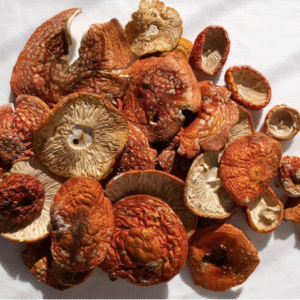
If collecting specimens for a herbarium or spore print collection, drying is absolutely essential. Use a food dehydrator on low heat for best results. Alternatively, hang them in a well-ventilated, dry area away from direct sunlight.
Light Protection
Protect dried specimens from direct light exposure whenever possible. Light gradually degrades bioactive compounds over extended periods. Store them in opaque containers in dark locations for maximum preservation.
Handling Practices
Always handle with clean, dry hands or appropriate tools. The dried specimens remain quite fragile and require gentle handling. Note that G. junonius does not reliably bruise blue, so never use bruising as an identification marker .
—
Applications and Use
For the Mycologist and Naturalist
Given its variable potency and potential toxicity, Laughing Gym is not recommended for recreational use. Its primary value lies in several academic and research areas:
· Taxonomic Study: Complex taxonomy and global distribution make it fascinating for amateur and professional mycologists alike.
· Ethnomycological Research: Traditional use in Japan (“Waraitake”) provides rich cultural context for study .
· Cultivation Science: Recent advances in artificial cultivation open new doors for research into its biochemistry and life cycle.
Dosage Guidelines
Disclaimer: Due to extreme variability in potency, presence of neurotoxic compounds (gymnopilins), and risk of misidentification with toxic lookalikes, consumption is not recommended. The information below is presented for educational purposes only.
When active specimens are consumed for psychoactive effects, onset typically begins within 20 to 60 minutes. Effects can last several hours depending on dosage and individual metabolism. However, effects remain highly unpredictable across different specimens and regions. Some sources note the LD50 for psilocybin is quite low at 280 mg/kg for mice .
Set and Setting Considerations
If one were to study effects in a controlled, legal research setting, set and setting principles would certainly apply. However, for the general public, treat this species as potentially poisonous. Do not consume it under any circumstances.
Integration Through Study
Study and documentation, rather than personal consumption, are the recommended ways to engage with this fascinating species. Its true value lies in scientific understanding rather than recreational use.


Reviews
There are no reviews yet.